A real need. A crowded set of solutions. An unproven opportunity in helping people delegate work and step back into their own computers.
Assessment based on current primary documentation and research, plus the Circe discussion. Competitor capabilities below are documented claims, not a hands-on comparison. Images are generated concepts. No Circe implementation was changed.
My verdict
Worth a focused experiment. Too early for a full product pivot. The original moment contains useful evidence: you wanted something done on a laptop without abandoning what you were doing on your desktop, then wanted to inspect and modify the result.
That establishes one person's need. It does not establish frequency, a market, willingness to pay, or an advantage over existing products.
The hypothesis to test
“I can work through any of my computers, delegate parts of that work, and take over without losing my place.”
Circe would earn its place by making that exchange dependable. Voice, device routing, automation and remote viewing would support it. Each is also available elsewhere.
The earlier architecture briefing describes a possible implementation. It should not be read as proof that the product direction is correct. This assessment puts demand, alternatives and interaction quality ahead of a wider build.
Who already serves parts of the need?
These companies are solving different problems
The presence of many startups shows there is substantial technical and commercial activity. It does not tell us which product Circe should build. Browser infrastructure can succeed selling capacity to developers even when a general personal assistant remains unreliable.
Assign tasks from a phone to a desktop. Computer use can operate apps and the browser. The current announcement lists macOS and Windows and requires the desktop awake and running.
Remote delegation is already a direct product offer. “Talk to an AI that uses your computer” is not an empty category.
Coordinates automation, AI agents and human interactions across business processes.
Enterprise process ownership is a different buyer and sales motion. General computer control does not automatically give Circe that business.
Representative comparison, not an exhaustive market inventory or a feature ranking. Documentation reviewed on 19 September 2026. Product plans, OS support and preview status change.
Why a convincing demo is much easier than a dependable product
Access is more than connectivity
An online node may have no unlocked graphical session. A command may reach the machine but miss the desktop, account, browser profile or open document the user meant. Pairing, OS permissions and sleep behavior are part of the product.
Cua documents Windows interactive-session boundaries and different background action mechanisms on macOS, Windows and Linux. Background operation is explicitly best effort, with some actions requiring foreground access. Source
An accepted click is weak evidence
A click can hit the right button while the request fails, the wrong account is selected, or a save remains pending. Completion needs observable evidence appropriate to the task: the reopened document, the saved value, or the resulting artifact.
This is an engineering requirement proposed for Circe. A fluent completion message cannot substitute for checking the result.
People change the environment
You can type, move windows, change a document or walk back to the laptop while the agent acts. “Take control” must pause conflicting automation and discard stale assumptions. “Continue” must inspect your changes.
For an initial version, serialize desktop input on each machine. Add background concurrency only where its behavior is demonstrated.
Recovery can cause damage
After a connection drops, did the remote app receive the final action? Retrying a submit or send can duplicate it. UI actions often lack a reliable request identifier or an undo operation.
Record uncertainty, inspect the target state, and ask when inspection cannot resolve it. Do not display “Stopped” until the remote worker has acknowledged that it stopped; disconnection is a different state.
The page is not the user
Web content, documents and tool descriptions can contain instructions the user never authorized. Scope execution to the user's request and approved resources, including the account and destination.
WebMCP's security guidance discusses origin isolation and sensitive tool handling. Structured tools improve access but do not establish intent or permission. Source
Long work exposes different failures
OSWorld 2.0 contains 108 extended workflows. Its published evaluation reports a best full-completion score of 20.6% under its 500-step configuration. The tasks have a median human duration around 1.6 hours.
That is not a predicted failure rate for Circe's short tasks. It is evidence that long tasks require separate evaluation; short demonstrations cannot establish broad autonomy. Benchmark and methodology
What WebMCP changes
WebMCP lets participating websites expose structured actions through JavaScript and annotated forms. Chrome documents it as a proposed web standard in origin trial. It can reduce the need to infer a site's controls, but requires site participation and an appropriate browser context. Chrome documentation
For Circe, treat it as one execution option alongside service APIs, browser automation, OS accessibility and visual control. Select by the required account, actual app state and action quality. An API that acts on a different account or stale copy is not automatically the better path.
It does not solve native desktop apps, machine sleep, conflicting human input, task recovery or verification. Building the product around universal WebMCP availability would be premature.
Visual exploration
Three ways the interface could behave
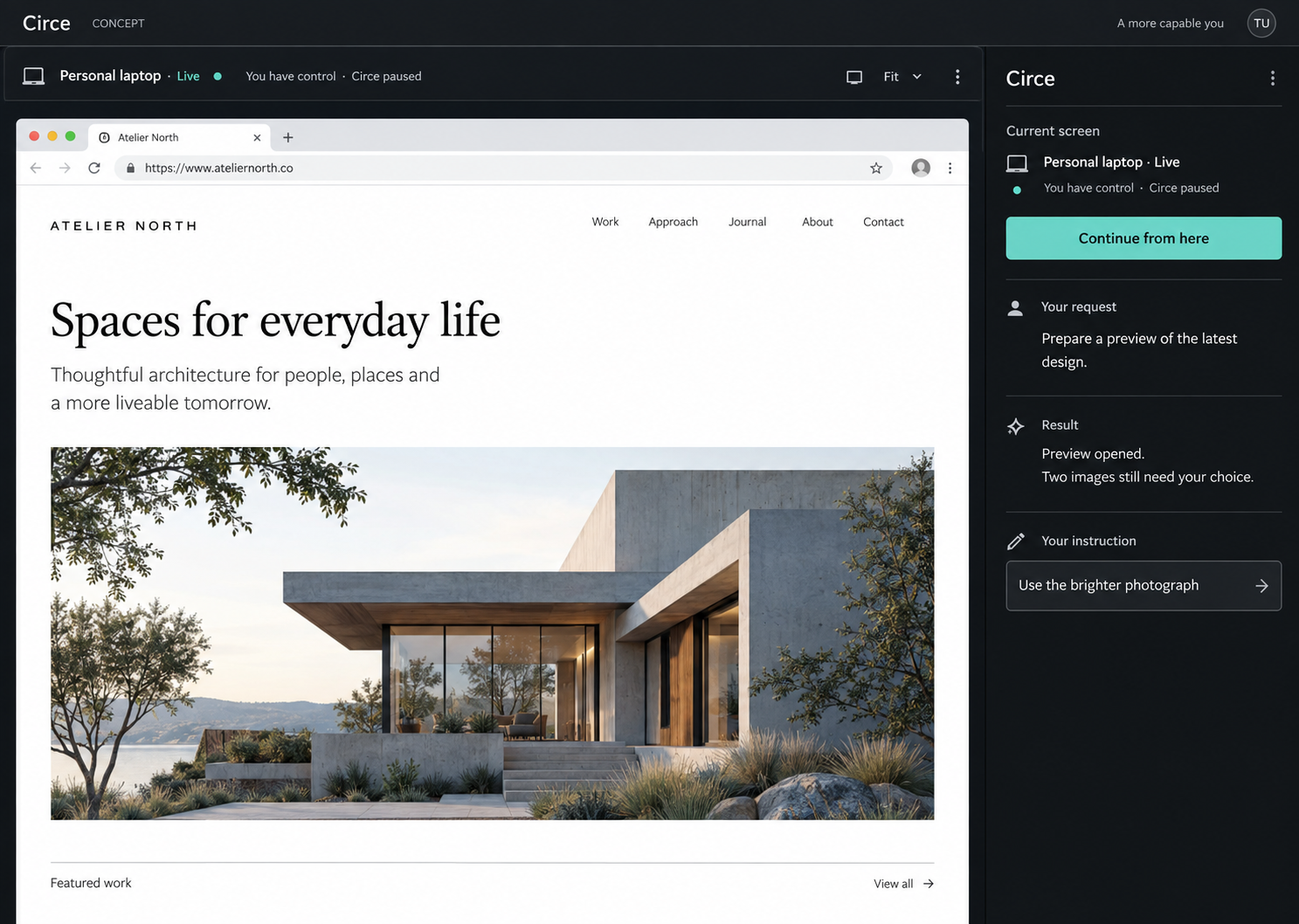
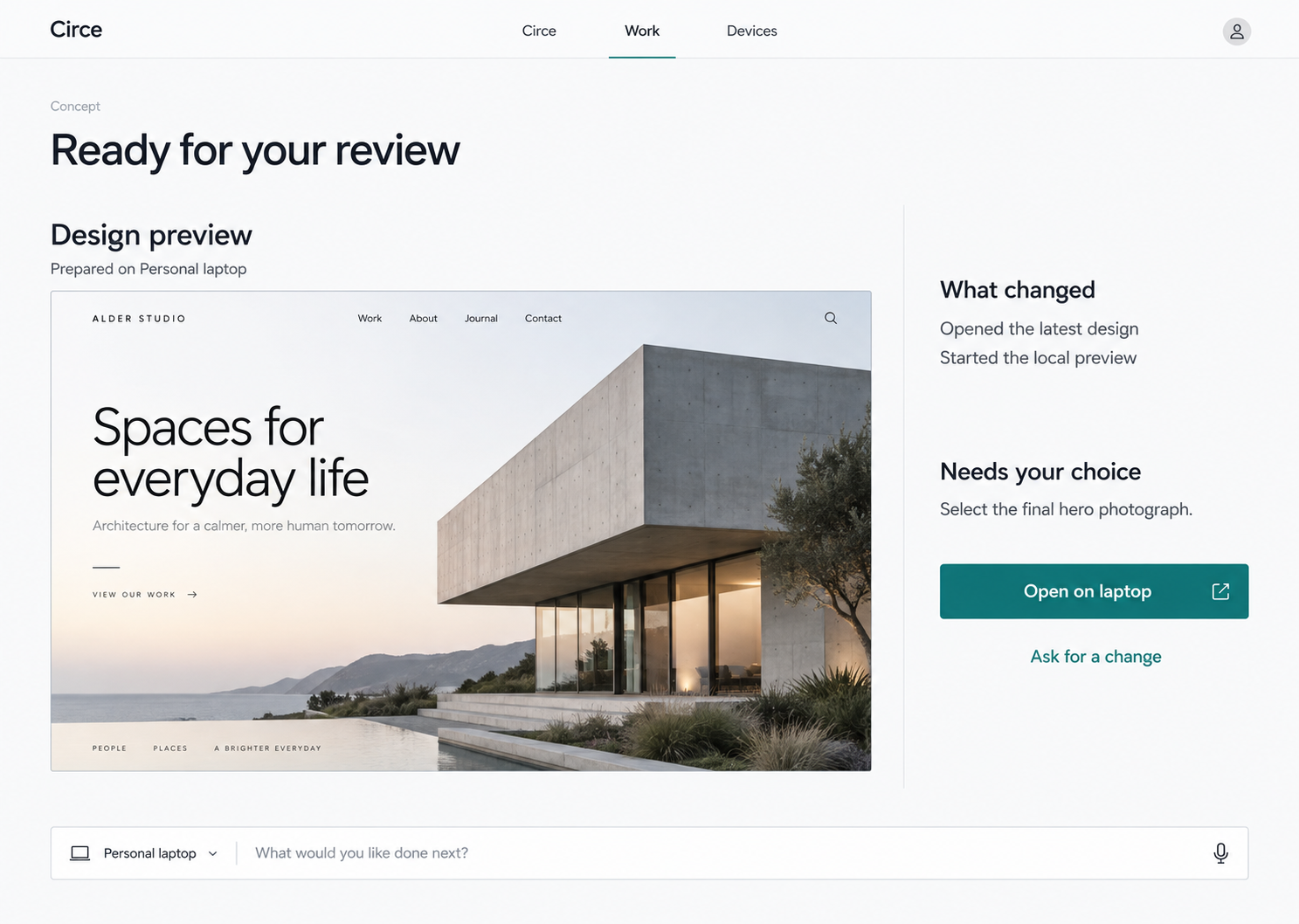
The images use one illustrative design task so the interface differences are easy to compare. Circe is not being defined as a portfolio builder. These are independent image concepts, not working interfaces or screenshots of shipped capabilities.
1 · Summon from where you are. Best for brief requests and quiet updates. Risk: a small panel can hide too much state. The panel should close after dispatch; completion must not steal game focus. The generated Stop control would need a real active operation behind it.2 · Work in the same session. The remote app occupies the screen. Circe pauses while you edit and resumes after inspecting the new state. This best tests the hybrid experience. Risk: it is still remote desktop unless delegation measurably reduces effort.3 · Return useful work. Show the output, remaining decisions and a route back into the original app. Useful for unattended work. Risk: reproducing every app's editing interface would create an enormous maintenance burden. Open the original app when editing is needed.
My hypothesis is that the small summon panel should expand into the shared session when needed. The result view is useful for work with a natural artifact. These can eventually coexist, but the first experiment should test one complete interaction rather than build all three shells.
The interaction to prove
Ask from desktop
Work on named laptop
Inspect live state
Take control
Change something
Continue from new state
Always show the machine and whether the view is live or stale. Give voice and typing the same capabilities. A machine may be offline, waiting for access, working, waiting for you, or finished with evidence. Use ordinary language for those states. Avoid a cheerful generic spinner.
Where Circe might earn a place
My candidate initial audience is people who already do meaningful work across two computers. That includes some developers, creators and technical solo operators. This is an audience hypothesis, not evidence that all those groups have the same needs.
Start with work that is tied to an existing machine: open local projects, configured tools, signed-in accounts and long-running processes. If a fresh cloud browser completes almost every requested task, the personal-machine thesis gets weaker. If users mostly want direct control, ship a useful remote-work product and keep autonomy modest.
Being open source and provider-neutral may help users choose Circe. Neither is sufficient protection from competition. A defensible advantage would have to emerge from superior setup, reliable task coverage and frequent use in a specific audience. We have not measured those yet.
Measure the effort the user gets back
These inputs are illustrative, not Circe measurements. A slow agent may still help if it frees attention. A fast agent may waste attention if it needs constant checking.
Net active time saved
min
The task returns time to the user under these assumptions.
Manual active time minus explanation, supervision, verification and recovery. Measure elapsed completion time, monetary cost and interruption burden separately. Setup and permission friction must also be amortized over real use.
The next step
A comparative field experiment
Run a proposed two-week pilot with roughly six to eight people who already use two computers. Begin with the actual operating systems and applications they use. This sample can reveal friction and repeated needs; it cannot establish market size.
Collect real requests before demonstrating Circe. Ask what they needed on another machine during the last week and watch them do it with their current method. Record missed requests too.
Compare with alternatives. Use direct remote desktop and an applicable agent product as baselines. Vary order to reduce learning effects. Do not infer competitor shortcomings from a documentation gap.
Test one complete Circe flow. One controller, one execution machine, a real browser and one native application on a chosen OS pair. Include observation, human takeover, resume and evidence of completion.
Record all attempts. Count autonomous completion, completion with help, honest failure, false success and harmful side effects separately. Log active minutes, elapsed time, interventions, setup/support effort and execution cost.
Observe voluntary return. Do people use it again without a reminder? Which tasks repeat? Which would they trust next time? Interview willingness to pay separately from willingness to try a free demo.
Reasons to continue
Several participants independently return for repeated work; delegation saves active time against their baseline; corrections are cheap; target and completion states remain understandable.
Choose numeric success thresholds after observing baseline task costs and before the comparison, rather than inventing impressive universal percentages.
Reasons to narrow or pivot
Requests happen rarely; most work could run in a generic cloud session; people routinely abandon the agent for direct control; setup dominates use; or one app/workflow accounts for nearly all value.
A concentrated workflow may justify a narrower product. Technical breadth is not a reason to ignore that result.
Minimum failure cases for the pilot
Wrong or ambiguous machine name: clarification before any mutation.
Machine online but locked or missing permissions: report the actual blocker.
Network loss immediately after an action: inspect before retrying.
User takes over mid-task: conflicting automation stops; continuation rereads current state.
A save appears successful but the artifact does not persist: no false completion.
Personal and work browser profiles both exist: visible account/profile scope.
Untrusted page content asks to change the task: retain the user's authorized scope.
Task is already satisfied: verify and finish without unnecessary edits.
What to build, reuse and postpone
Own in Circe
Evaluate for reuse
Postpone
Named machine and account scope; task lifecycle; understandable status; safe exchange of control; result verification; resuming after user changes.
Browser execution engines, desktop drivers, screen transport and networking. Compare support, licensing, integration effort and failure behavior before selection.
A universal agent model, every OS at once, phone-wide control, a new browser, generic business workflow authoring and “anything on any device” claims.
The browser and desktop work already underway is useful as an execution foundation. Its next milestone should be a coherent user task that survives interruption and correction. Tool count alone cannot establish readiness.
Proposed responsibility chain: user request → resolved machine and scope → durable task → appropriate execution adapter → observed result → review or direct takeover. Keep voice transport separate from task lifetime, and keep execution on the selected node across reconnects. This is a direction for an experiment, not a finalized architecture.
What remains unknown
We have not compared these products hands-on, measured Circe's task success, established setup cost across OS pairs, interviewed users, or tested willingness to pay. The research makes the alternatives and constraints clearer. It cannot honestly answer those questions for us.
Recommended next action: build a corpus of real requests from your own two-machine use, then compare one complete delegate–takeover–resume flow against doing the work directly.
Generated UI images are illustrative and contain invented content. They were made with the built-in Image Gen tool, grounded in Circe's crisp panel and control geometry. No computer-control or browser acceptance tests were run for this briefing.